
How many times when you were a kid did you hear phrases like Stop! Be careful! Don’t do that! or something similar? How many times have you uttered one of those phrases to your own child? Generally, when one of these phrases comes out of the mouth of a parent, the goal of protecting a child from a danger he may not notice himself is on Mom or Dad’s mind. Let me give you an example.
Picture this scenario: It’s July 4th, 1983. The grill is going. It’s about 90 degrees. 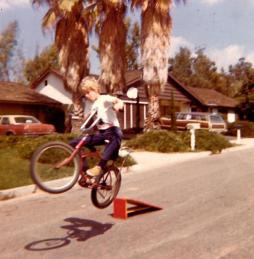 People are swimming in the pool. Aunts, uncles, parents, and grandparents are enjoying a fun picnic atmosphere as they shoot the breeze or reminisce about gatherings past while you and some of your cousins are riding your bicycles around the yard. As 10-12 year old boys often do, you and your cousins had the bright idea to build a ramp to jump over the sandbox. As you take turns jumping and raising the ramp, Dad notices and utters the warning, “I wouldn’t build that much higher if I were you.”
Right. What does he know. Go back to your hunting story, Dad.
Now understand, at this point the ramp is at about 50 degrees and the front of it is between 24 and 30 inches high, and we were hitting it after coming down a pretty steep hill, so we were probably running about 15-20 mph (which to some of you cyclists might not sound that fast, but when your 10 years old and you can’t make your legs go fast enough to keep up with pedaling, it’s pretty darn fast). I don’t remember how many times we jumped the ramp up to that point, but I remember my last jump. I remember being airborne. I remembering feeling like I was Evel Knievel. I remember landing and my feet slipping off the pedals. And, I remember coming down on the crossbar – crotch first.
Now, I’m not sure what my dad saw that led to his original warning. Was it my wet shoes? Was it his knowledge that as the ramp got higher, we were more likely to go less far horizontally and so actually have the back tire land in the sand causing an abrupt velocity change? I have no idea, but I do know one thing. He recognized danger and tried to warn me to steer clear, and I did not heed his wisdom. Thus, I paid the price, and by proxy so did my dad and every one of my uncles who witnessed it – right after the wincing and chuckling died down. (BTW – if you read the “landing on the crossbar” part and immediately felt a sympathetic twinge of pain, you can thank your mirror neurons for that.)
This notion of recognizing the value of wisdom and steering clear of potential pain-causing problems is exactly the message of Proverbs 3. From verses 25 – 31, the author of Proverbs gives us 6 “Don’t Do Its” meant to prevent us from coming to harm.
- Don’t be afraid of sudden terror or the ruin of the wicked. (v. 25)
- Don’t withhold good from those to whom it’s due. (v. 27)
- Don’t tell your neighbor to come back tomorrow when you have what they need now. (v. 28)
- Don’t plan evil against your neighbor. (v. 29)
- Don’t pick fights for no reason with someone. (v. 30) – Some people would do well to remember this on social media. In my past, I know I have been one of them.
- Don’t envy a violent man, and don’t act like him either. (v. 31)
Six don’ts. All of them straightforward wisdom to live by from a God who loves us and wants what’s best for us. Each of them spoken from an understanding of the dangers that lie in wait should we ignore God’s ever-prudent words. This understanding is how we must approach the do’s and don’ts God gives us throughout his Word – He recognizes dangers that we don’t see for ourselves. Sometimes they may be dangers from without, and sometimes they may be dangers from within. In either case, He knows. He always knows. And so, we should trust Him and listen to His guidance because every one of those 6 don’ts is predicated upon dwelling in and acting from God’s wisdom, which we will only do if we trust Him.
Maybe that’s why the don’ts come after a poignant, yet unspoken, do.
Trust in the Lord with all your heart, and do not lean on your own understanding. In all your ways acknowledge him, and he will make straight your paths.
Proverbs 3:5-6 (ESV)
If we are willing to trust God, which is arguably the beginning of wisdom, then we will be willing to heed his wisdom, which can help us not to come crashing down on the crossbars of life quite as often. We obtain the positive of a closer relationship with God, and avoid the negative of unnecessary pain. If you need a place to start, the very next verse, Proverbs 3:7, provides advice as easy to follow as 1, 2, 3.
- Be not wise in your own eyes;
- Fear the Lord, and
- Turn away from evil.
Trust God’s wisdom and not your own. Reverently fear the maker of the universe and everything in it. When evil comes your way, turn away from it and run to your Father.
Seems like a great place to start.
 drbillduvall.com